
The question of .38 vs 9mm is really "is .38 Special so good that I should have a revolver instead of a semi-motorcar in 9mm." Is information technology?
Basically no. Only it's also truthful that it doesn't mean that a person armed with a .38 Special, who knows what they're doing, is necessarily at a serious disadvantage
Of the medium bore calibers, these are the two most common chamberings. There are fans of both, and both have been used (and used a lot) for every possible purpose you lot tin can utilise a handgun for.
Both have been in use in constabulary and military service pistols since the dawn of the 20th century. Both have been used and are useful for defensive purposes, both have been used and are useful for competition as well.
And so which is "better"? It kind of depends on how you hateful that…
.38 Special: The Onetime Standard

.38 Special, or more than accurately .38 Smith & Wesson Special, was one of the first pistol cartridges to be fabricated with smokeless powder, as it came at the stop of the black pulverization era.
The .38 caliber cartridges, including .38 Special, were the continuation of .36 caliber percussion pistols into the cartridge era. .36 caliber guns were some of the nearly popular for personal protection and police apply, so cartridges like .38 Long Colt, .38 Smith & Wesson and .38 Smith & Wesson Special were substantially continuations on the theme.
.38 Special was the hot load of its mean solar day, using a touch more than smokeless pulverization than .38 Long Filly. The original load was a 158-grain roundnose lead bullet at somewhere between 800 and 900 anxiety per 2d (depending) and 310 ft-lbs of energy out of a half-dozen-inch barrel.
While piece of cake to shoot, the original police load was long considered little better than adequate, which is why .357 Magnum revolvers were the default police sidearm from the 50s onward.
Service loads would be refined in the 1950s and 1960s, culminating in the classic FBI/Metro/Chicago load, a 158-grain lead semiwadcutter hollow point loaded to 20,000 psi with a +P designation which kickoff saw use in the early 1970s.
However, the 158-grain load was known for being less reliable in snubnose revolvers, leading to the development of the "New York load" by Speer in the 1990s. The New York load is a 135-grain JHP with a +P loading at 860 fps from a 2-inch barrel.
The gist of .38 Special is that it's a medium bullet at medium velocity. It can be effective for personal defence simply armament selection (and placement!) is important, specially if your gun has a shorter barrel length.
The upside to .38 Special is that it's cheaper than .357 Magnum (though not by much) and is a very mild cartridge to shoot from a service pistol. Snubbies get a scrap snappy, which is partially why a lot of people believe the circular-butt medium frame is the better pick for a fighting pistol.
9mm Is The Default Pistol Cartridge For A Reason

9mm, besides chosen 9mm Luger, 9x19mm or past it'south formal championship 9mm Parabellum, is the default pistol cartridge of today and for a bevy of good reasons.
The cartridge was developed past Georg Luger in 1901, as a new chambering for his pistol (the Luger, duh) which was originally developed with a hot .32 caliber cartridge (.30 Luger/vii.65mm Luger, itself a derivative of 7.65mm Borchardt) but the German government (at the time the German Empire) wanted a bigger bullet.
So he rejiggered the instance for a 9mm (.355-in) bullet, and the original load was a 115-grain full metal jacket projectile, loaded to roughly 1150 fps velocity, 350(ish) ft-lbs of free energy and 34,000 to 35,000 psi of chamber pressure.
The cartridge was constitute to exist reliably effective on hostile personnel out to 50 meters and even beyond with good marksmanship, with a relatively apartment trajectory (meaning information technology doesn't drop until much further downrange) and moderate recoil.
The cartridge was quickly adopted by the German empire and by a succession of governments later on. Near all of the Western countries had adopted it by the mid-20th century, and all NATO countries had adopted it by the 1980s.
NATO's loading is slightly hotter, with the typical NATO load existence a 124-grain FMJ projectile at the same velocity (1150ish) every bit the original 115-grain load.
In police service, 9mm found limited adoption until the 1970s generally due to poor terminal performance with 9mm FMJ ammunition. The first generations of jacketed hollow points fabricated some moderate improvements simply notwithstanding roughshod short compared to .45 ACP JHP and .357 Magnum/.38 Special police force loads.
However, the carrying chapters advantage made too skilful a case for itself for anyone to ignore. While .40 S&West did get adopted past a large number of agencies and departments, the appearance of mod bonded hollow points completely overcame performance deficiencies of cup-and-core bullets.
Equally a outcome, the world's law and armed forces forces accept standardized on 9mm and the rest of the shooting globe has followed suit...and for good reason. The 9mm Luger cartridge is piece of cake to shoot, allows for more than cartridges to be carried in a magazine, and with modern quality ammunition (and expert placement) is more than constructive enough for personal defence force.
So are there whatsoever serious reasons to call back of getting a revolver that doesn't chamber 9mm?
But First, Well-nigh .38 Special Revolvers And Butt Length…

Still, it's worth thinking almost that a brusque-barrel .38 Special and a .38 Special service revolver are dissimilar animals. .38 Special is a depression-velocity cartridge to begin with; chopping half the butt off makes it fifty-fifty less so.
That'southward why load selection is critical. If you're going to be about that snub life (and there is something to it!) yous demand to advisedly research what loads are really worth carrying and certain it shoots to your sights.
The loss in velocity going from a iv-inch butt to a 2-inch barrel with the same load is anywhere from 50 fps to 200 fps. Expanding ammunition has an expansion threshold; beneath a minimum of velocity, the bullet doesn't deform or expand (or exercise then as reliably) every bit it does from a longer barrel. Therefore, the more barrel the amend.
Most people who buy .38 Special revolvers these days tend to be buying snubbies; when people purchase medium-frame guns with a four- to 6-inch barrel, they're usually buying .357 Magnums.
Have a look at the Lucky Gunner Labs test of .38 Special defensive loads. What you'll run across is that a lot of .38 Special loads run across the test protocol (12 inches to eighteen inches penetration in gel through several layers of vesture) but are often marginal, only coming together the minimum. 9mm ammo tests reveal modern defensive loads practise far ameliorate than just meeting the minimum.
That also isn't new; the 1989 FBI ammo tests that resulted in the agency adopting 10mm Auto as their new service cartridge likewise constitute .38 Special (and 9mm) to be less than totally acceptable through a 3-inch barrel with the duty loads of the day.
Information technology's as well worth noting that if you await upwardly the top instructors who specialize in snub courses (Greg Ellifritz, Darryl Bolke, Chuck Haggard, Claude Werner) tend to prefer snubbies in .22 Magnum or .327 Federal instead.
.38 Special Handloads vs 9mm Handloads: Perchance The One Advantage

(Credit: Wikimedia Commons)
In that location is 1 area in which .38 Special has some advantage over 9mm, and it exists purely on newspaper. It will do very little or zippo for y'all in the real world except let you tinker with some stuff that goes "boom!"
That, of form, is handloading your ain bullets and it is in this respect that .38 Special is "amend" than 9mm. The .38 Special instance, you run into, is a handloader's playground; information technology is forgiving and has vastly more potential than the 9mm case.
The .38 Special instance is loaded with fiddling propellant relative to example volume; the example holds 23 grains of water but is only loaded to 17,500 psi of chamber pressure, compared to 26 grains of water and 35,000 psi for .357 Magnum. In other words, it's loaded lite.
9x19mm, however, holds less than 14 grains of h2o. Overpressure loadings (+P and +P+) of 9mm are rarely more than 100 fps faster than the standard pressure with the same projectile.
However, a .38 Special can be hot-loaded. Dorsum when Elmer Keith and his friends tinkered with .38 Special in the 1920s, they got a 158-grain bullet to well over 1,100 fps, a 300 fps increase over standard-force per unit area 158-grain loads. It was fifty-fifty sold commercially as the .38/44, for use simply in the Smith & Wesson .38/44 Heavy Duty and Outdoorsman revolvers.
And so, if y'all want to hand-gyre the hot stuff, and you take a revolver that's made for it (use a medium frame gun or larger that'due south chambered for .357 Magnum like a GP100) the .38 Special is perfect for information technology.
38 Vs 9mm
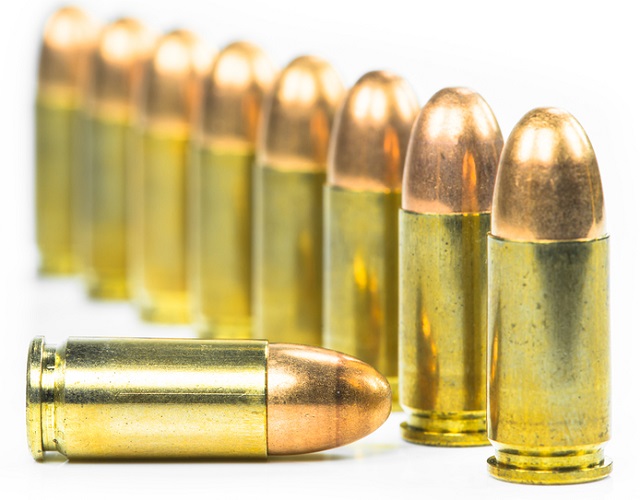
The virtues of 9mm are such that there's no reason to opt for a .38 Special revolver, except for certain circumstances. That'due south why inappreciably anyone makes revolvers and everyone makes semi-autos in 9mm. That's why all police and militaries have switched to 9mm pistols.
.38 Special doesn't have any advantages over 9mm in any attribute, except maybe for handloaders.
That doesn't hateful a .38 revolver is worthless if that's what you lot have. In that location's something to be said for "run what you lot brung;" if granddad'south police revolver or a snubbie is what y'all have, you can larn to run information technology.
A lot of good piece of work got done with Law Positives, Model 10s and J-frames, and so you tin be capably armed with one but it takes a lot of practice. You only have v or six shots to get the hits, then you really need to learn how to get them.
There is something to exist said for covert comport in a legal only non-permissive environment. A snubbie in a pocket holster or an ankle holster or something along those lines can be easily curtained when getting discovered comes with consequences beyond getting asked to leave Starbucks.
Revolvers likewise, let's face it, are obsolete and are seen that way by anybody, which tin really exist a positive.
Some states, cities or counties (and their jury pools) have different regulatory and social attitudes about guns than others. Even if owning a Glock or whatever may exist perfectly legal, local law and prosecuting attorneys may meet that black double-stack 9mm every bit a willingness to shoot people. Grandpappy'southward Police Positive? Not and so much.
With that said...
The reality here is 9mm is overall the amend cartridge. It'southward cheaper to buy. Quality 9mm armament tends to outperform the best .38 Special loads in police and defensive apply.
Annihilation larger than a Glock 43 has more carrying chapters. If that didn't matter, John Browning and Dieudonne Saive wouldn't have bothered inventing the Browning Hello Ability. That's likewise why every modern service pistol is chambered in 9mm and has a double-stack mag.
A S&Due west Shield or P365 or what have you is besides easily concealed, and the modern double-stack micros (Shield Plus, P365, Hellcat, Ruger Max 9) are smaller than a J-frame and have twice (or more) the carrying capacity.
While .38 Special (and the guns that fire information technology) is non bad by any stretch, information technology's that the cartridge has basically no reward over 9mm even if handloaded to near-.357 Magnum velocities which a conscientious handloader tin can practice.
Revolvers have a few advantages, as mentioned, simply they aren't actually enough for most people to go a wheelgun instead of a modern pistol.
About The Author

DOWNLOAD HERE
Posted by: webbancessitneve1958.blogspot.com


0 Comments